How to Centre Clay on a Pottery Wheel
Introduction: The Foundation of Every Thrown Pot
Ask any experienced potter what separates a beginner from someone who can throw consistently well, and the answer is almost always the same: centring. It is the single most important skill in wheel throwing, and it is also the one that takes the longest to master. Before you can pull up walls, shape a bowl, or trim a base, the clay must be perfectly centred on the wheel head. If it is not, everything that follows will fight against you.
Centring is the process of bringing a lump of clay into a state where it rotates evenly on the spinning wheel without wobbling, shifting, or pulling to one side. When clay is truly centred, it feels almost alive under your hands — smooth, steady, and obedient. When it is not centred, you will feel a rhythmic thud or pulse, and the clay will seem to resist every attempt to shape it.
This guide is written specifically for beginners taking their first steps into wheel throwing in the UK. Whether you have just signed up for a class at a local pottery studio, recently purchased a second-hand wheel, or are attending a beginner’s course at a community arts centre, the principles here are universal. With the right technique, consistent practice, and a good understanding of what you are trying to achieve, centring will eventually become second nature.
Understanding Clay Bodies for the Wheel
Before you sit down at the wheel, it helps to understand the material you are working with. Not all clay is suitable for wheel throwing, and choosing the wrong type will make centring significantly harder.
For wheel throwing, you need a clay body that is plastic (meaning it is flexible and responsive), well-wedged, and at the right consistency — firm enough to hold its shape under pressure, but soft enough to move. In the UK, a wide range of suitable throwing clays are available from reputable suppliers. Some of the most well-regarded include:
- Scarva Pottery Supplies (based in County Down, Northern Ireland) — offers a popular smooth white stoneware that is forgiving for beginners.
- Potclays (Stoke-on-Trent) — one of the oldest pottery suppliers in the country, selling a wide range of earthenware, stoneware, and porcelain throwing bodies.
- Bath Potters’ Supplies (Bath, Somerset) — well known for quality stoneware clays suited to both hand building and wheel work.
- CTM Potters Supplies (Westbury, Wiltshire) — a reliable source for throwing clays and tools, popular with studio potters across southern England.
As a beginner, avoid porcelain. It is notoriously difficult to centre and throw due to its low plasticity and slippery nature. Start with a mid-fire stoneware or a smooth earthenware — both are considerably more forgiving and will respond better to the techniques described below.
Clay sold commercially in the UK typically comes in 12.5 kg bags. A good starting weight for a beginner throwing session is between 500 g and 750 g of clay per piece. This is manageable enough to centre without needing great physical strength, but substantial enough to practise the technique properly.
Wedging: The Step You Cannot Skip
Centring becomes dramatically easier — and safer — when you start with properly wedged clay. Wedging removes air pockets from the clay and creates a uniform, even consistency throughout the mass. Air bubbles trapped in clay can cause pieces to explode in the kiln, but they also create inconsistencies that make centring frustrating and unpredictable.
There are two main wedging methods: ram’s head wedging and spiral wedging. Ram’s head wedging is generally taught first and involves repeatedly pushing the clay down and forward in a rocking motion. Spiral wedging is more efficient for larger amounts and, once learned, creates a beautifully homogenous lump of clay. Ask your tutor to demonstrate both methods if you are attending a class.
After wedging, form the clay into a rough ball and pat it firmly onto the centre of the wheel head. A good initial placement matters — the closer to centre you can get it before the wheel starts spinning, the less work you will have to do.
Setting Up Your Wheel and Workspace
Good posture and positioning at the wheel are often overlooked by beginners, yet they make a significant difference to your ability to apply controlled, consistent pressure.
- Seat height: Adjust your seat so that your elbows can brace against the rim of the wheel tray or your thighs. Your arms should not be floating unsupported in the air.
- Proximity to the wheel: Sit close enough that you can lean forward and place your hands on the clay without overreaching. Leaning too far forward tires you out quickly and reduces control.
- Water and a sponge: Keep a bowl of water nearby. You will need to keep your hands and the clay lubricated throughout the throwing process. Dry hands on spinning clay cause friction that can drag the piece off-centre.
- Wheel speed: For centring, you want the wheel spinning quite fast — typically near full speed. This is counterintuitive for beginners who often slow the wheel down because it feels less intimidating, but a faster wheel gives you more rotational force to work with.
If you are using a kick wheel rather than an electric wheel, practise getting a steady, consistent rhythm with your foot before placing your hands on the clay. Inconsistent wheel speed will make centring much harder.
Step-by-Step: How to Centre Clay
The following steps outline the centring process from start to finish. Read through the entire sequence before you begin, so you understand the goal of each stage before you attempt it at the wheel.
- Secure the clay to the wheel head. With the wheel stationary, press your clay ball firmly onto the centre of the wheel head. Use the heel of your palm to compress it downward. If you are using bats (removable discs attached to the wheel head), make sure the clay is pressed firmly against the bat surface. Some potters score the wheel head lightly with a rib or use a small amount of water to help the clay grip.
- Start the wheel at high speed. Wet your hands thoroughly and start the wheel at a fast, consistent speed. Approach the spinning clay calmly and deliberately. Beginners often tense up at this point — try to relax your shoulders and breathe steadily.
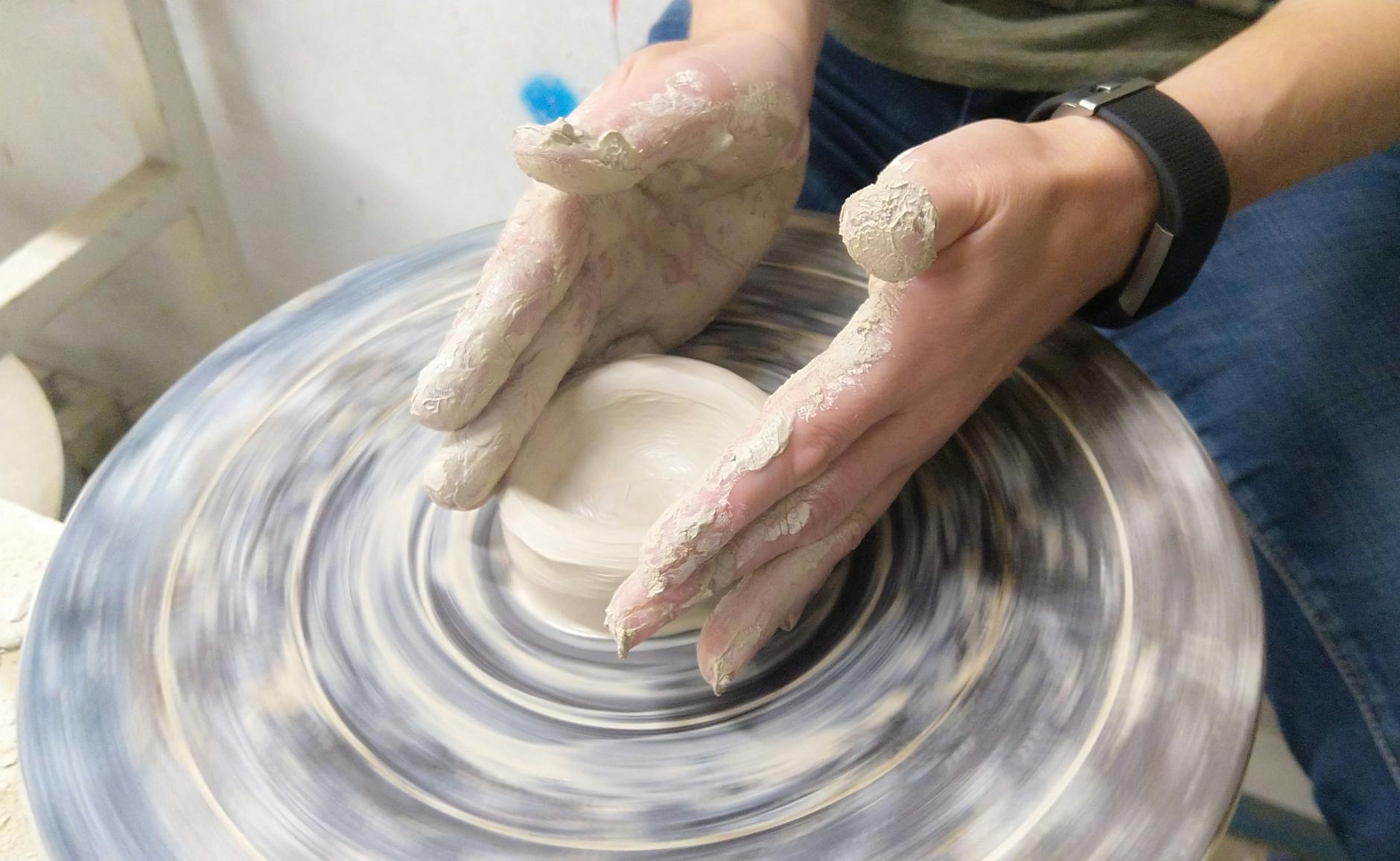
- Cone up the clay. Place both hands around the clay and squeeze inward and upward simultaneously, pushing the clay into a tall cone shape. This is sometimes called “coning up.” The purpose is to align the clay particles and work out any remaining inconsistencies from wedging. Keep your elbows braced against your body or the wheel tray. Apply firm, even pressure — not a sudden grip, but a sustained squeeze.
- Press the cone back down. With your dominant hand flat on top of the cone and your other hand supporting the side, press downward firmly and steadily to flatten the cone back into a dome shape. Keep the pressure even and use your body weight rather than just arm strength. Leaning forward slightly helps you apply downward force more efficiently.
- Repeat the cone up and press down cycle. Most beginners need to repeat the coning up and pressing down sequence two or three times before the clay begins to centre properly. Each cycle works the clay further into alignment. Do not rush this stage.
- Check for wobble. As the clay spins, watch the silhouette of the clay from the side. If it is wobbling or pulsing, it is not yet centred. A centred piece of clay will appear perfectly still, even though it is spinning rapidly. You can also hold a finger lightly against the side of the clay — if it pushes your finger rhythmically, the clay is still off-centre.
- Apply the “cup” or “crab claw” grip to finalise centring. Once the clay is close to centred, form a cup shape with both hands around the clay. Your left hand presses inward from the side while your right hand presses downward on top (reverse this if you are left-handed). The combined inward and downward pressure, applied simultaneously and steadily, brings the clay into its final centred position. Keep your elbows locked against something solid.
- Confirm the clay is centred before proceeding. Before you move on to opening the clay, confirm that it is truly centred. Hold a still finger lightly to the side of the rotating clay. If there is no push or wobble, you are ready to proceed. If there is still movement, go back to coning and pressing until it is resolved.
Common Mistakes and How to Correct Them
Centring is a skill built through repetition, and most beginners make the same set of mistakes. Understanding what typically goes wrong — and why — will help you correct problems more quickly.
Using too much water. Water is a lubricant, not a solution. Using excessive water weakens the clay and makes it collapse more easily. Use just enough to prevent friction — your hands should feel slippery but not soaking. Add small amounts frequently rather than drenching the clay at the start.
Gripping too tightly and too briefly. Many beginners apply short, jabbing pressures to the clay rather than long, sustained squeezes. This causes the clay to wobble unpredictably rather than easing into alignment. Think of your hands as tools applying steady, controlled force rather than pushing or hitting.
Not bracing the arms. If your arms are floating freely in the air, you will be unable to apply consistent, controlled pressure. Always brace your elbows against your knees, thighs, or the wheel tray. This transforms your whole upper body into a single stable unit, which is far more powerful and consistent than arms alone.
Slowing the wheel too much. A slower wheel is more forgiving if you make mistakes, but it also gives you far less mechanical advantage when centring. Keep the wheel fast during the centring phase and slow it down only when you begin to open and pull up the walls.
Stopping too early. Beginners often think the clay is centred before it actually is. The clay may look roughly centred while stationary, but the true test is at speed. Always check by touching the side gently with a still finger before you proceed to opening.
Building Strength and Muscle Memory
Centring requires a particular kind of physical strength — not brute force, but sustained, directed pressure from a stable position. Many beginners find that their hands, wrists, and forearms tire quickly in the first few sessions. This is entirely normal and will improve with practice.
A few targeted exercises can help outside of pottery sessions. Squeezing a stress ball or grip
strengthener builds the grip endurance needed to hold clay steady under pressure. Wrist rotations and forearm stretches performed daily can reduce the stiffness and soreness that tends to follow early throwing sessions. Some potters also find that regular kneading of a stiff clay body — even away from the wheel — trains the hands to apply consistent, even force without tensing the shoulders.
Posture plays an equally important role. Sitting too far from the wheel head forces the arms into an extended, weakened position, making it far harder to brace effectively. Ideally, your elbows should be able to rest against or just inside your knees, creating a solid triangular frame through which force can be directed downward and inward rather than being absorbed by your joints. Adjust your seat height before each session until this position feels natural, and take short breaks if you notice your shoulders creeping upward — tension in the upper body travels straight into the clay.
With consistent practice, centring gradually stops feeling like a struggle and begins to feel instinctive. Most students notice a meaningful improvement between their fourth and eighth sessions, not because their technique has changed dramatically, but because their body has begun to remember the required positions and pressures without conscious effort. Keep a simple log of what worked and what did not after each session; patterns emerge quickly and give you something concrete to focus on during your next attempt.
Conclusion
Centring is the foundation upon which every piece you throw depends. A poorly centred mound will cause uneven walls, a lopsided rim, and frustration at every subsequent stage of the making process. Approached with patience, correct body mechanics, and a willingness to slow down and reset when needed, it is a skill that any committed beginner can acquire. Give yourself time, keep your tools simple, your water use disciplined, and your wheel speed deliberate — and the clay will, in time, respond reliably to your hands.