
The History of British Pottery: From Wedgwood to Studio Ceramics
Where It All Begins
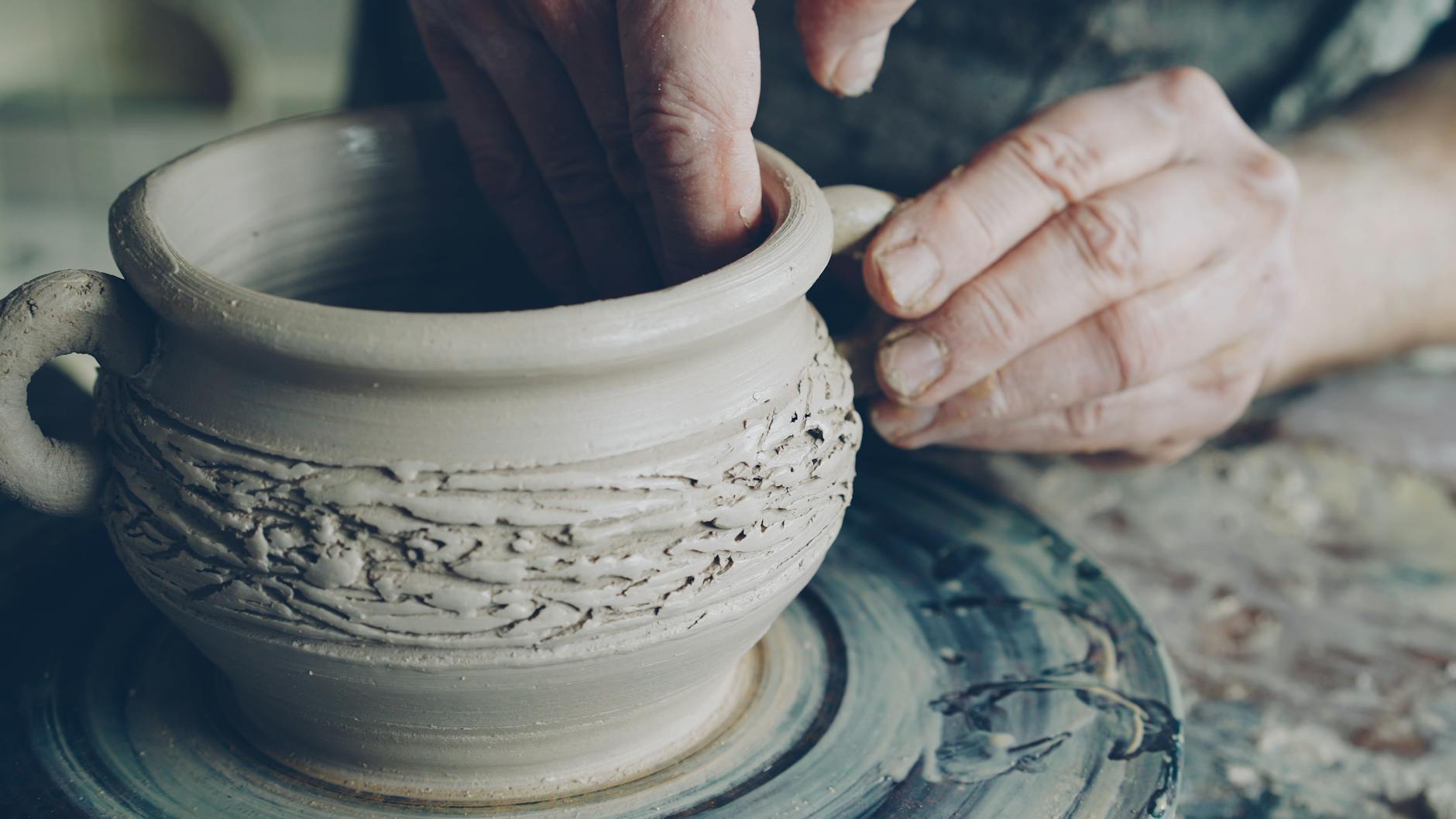
Walk into almost any charity shop in Britain and you will find it: a slightly lopsided mug, glazed in an ambitious shade of teal, with a thumb-print pressed into the handle where someone lost their grip before the clay stiffened. It is not a beautiful object by any conventional measure, but it is an honest one. Someone made it with their hands, probably on a rainy Saturday afternoon at a local pottery class, and that act of making connects them to a tradition that runs deeper into British soil than almost anything else.
Pottery is one of the oldest crafts practised on these islands. Long before the Romans arrived with their amphoras and their imported Samian ware, communities across Britain were shaping clay into functional vessels. They were storing grain, carrying water, and burying their dead with pots placed carefully at their sides. The material itself — clay pulled from riverbanks, from cliffsides, from the rich seams running beneath counties like Staffordshire, Devon, and Dorset — has always been here, waiting. Understanding that history does not just give you context. It gives you confidence. When your first bowl collapses on the wheel, it helps to know that potters have been collapsing bowls in this country for several thousand years and somehow kept going.
The Roman Influence and Medieval Foundations
When Roman legions settled across Britain from around 43 AD, they brought with them sophisticated kiln technology and a taste for highly decorated, wheel-thrown ceramics. Towns like Colchester and York became centres of pottery production, supplying the army and civilian populations alike. The distinctive red-gloss Samian ware was largely imported from Gaul, but British potters quickly adapted, producing their own versions using local clays and developing regional styles that reflected their particular materials.
After the Romans withdrew in the early fifth century, pottery production did not disappear — it simplified. Medieval English pots tend to be rougher, hand-built or thrown on slow wheels, fired in clamp kilns rather than the sophisticated updraught kilns the Romans had used. But they are not unsophisticated. Visit the collections at the Museum of London or the Yorkshire Museum in York and you will find medieval jugs glazed in honey-brown lead glaze, decorated with applied clay pellets and incised lines, full of character and intentionality. These were not the products of careless hands. They were the work of people who understood their material deeply, even if they lacked the technical resources of earlier traditions.
By the thirteenth and fourteenth centuries, specific pottery-making regions had begun to establish themselves. Surrey and Kent produced distinctive wares. The Midlands, with its rich seams of plastic clay, was already becoming the heartland of British ceramics. And potters were beginning to experiment — with different clays, different temperatures, different decorative techniques borrowed from trade connections with Europe and, eventually, with Asia.
The Staffordshire Revolution
If you want to understand British ceramics, you have to go to Stoke-on-Trent. The city — actually a federation of six towns including Burslem, Hanley, and Longton — earned the name “The Potteries” for reasons that become immediately obvious when you read its history. The combination of local coal deposits for firing kilns, abundant clay reserves, canal networks for transporting fragile goods, and a workforce that accumulated generational expertise made this region the engine of British ceramic production from the seventeenth century onwards.
It was here that Josiah Wedgwood set up his Etruria factory in 1769, and changed not just British pottery but global manufacturing. Wedgwood was not simply a talented potter — though he was that. He was an obsessive experimenter, a shrewd businessman, and a man who understood that beautiful objects needed to be seen by the right people. His development of creamware, a refined, cream-coloured earthenware that was both elegant and affordable, democratised fine tableware. His Jasperware — that distinctive pale blue stoneware with white classical relief decoration — became one of the most recognisable British design signatures in the world, and remains in production today.
Wedgwood also understood the power of endorsement. When Queen Charlotte agreed to be named patron of his creamware, he renamed the range “Queen’s Ware” and the orders flooded in. He sent complete dinner services to Catherine the Great of Russia. He marketed anti-slavery medallions bearing the words “Am I Not a Man and a Brother?” — turning his pottery into a vehicle for political statement as well as domestic elegance. As a beginner interested in British ceramics, spending time with Wedgwood’s story is genuinely illuminating, not because you need to make anything like Jasperware, but because it illustrates how technically rigorous and culturally ambitious this craft has always been.
Wedgwood was not alone. The same era produced Spode, who is credited with perfecting bone china in the 1790s — a fine, translucent white ware made with calcined ox bone mixed into the clay body. Minton, Royal Doulton, Royal Worcester: these names built empires from clay and fire, and their surviving factory buildings, bottle kilns, and museum collections are still accessible to visitors today. The Gladstone Pottery Museum in Longton is one of the best preserved Victorian pottery factories in the world and is absolutely worth a visit if you are serious about understanding where British ceramics came from.
Arts and Crafts, and the Reaction Against Industry
By the mid-nineteenth century, industrial pottery production had become extraordinarily efficient and extraordinarily soulless. Factories turned out thousands of identical pieces a day. Division of labour meant that a single pot might pass through twenty pairs of hands without any one person understanding the whole object. It was the Arts and Crafts movement — led by figures like William Morris, who was deeply suspicious of what industrialisation was doing to both workers and the objects they made — that began to push back.
The movement celebrated handcraft, individual skill, and the honest expression of materials. In ceramics, this found expression in the work of artists like William De Morgan, who created extraordinary lustre-decorated tiles and vessels inspired by Islamic and Persian traditions, producing much of his work in studios in Chelsea and later Merton Abbey. Martin Brothers Pottery, operating out of Southall in west London from 1873, produced extraordinary stoneware — grotesque, highly individual, full of strange faces and birds with removable heads — that looked like nothing else being made anywhere in Britain.
These makers were not producing for mass markets. They were exploring what pottery could be when freed from commercial constraints, and they were laying the ground for everything that would come after.
Bernard Leach and the Studio Ceramics Movement
No figure looms larger in modern British ceramics than Bernard Leach. Born in Hong Kong in 1887, trained in Japan under the master potter Ogata Kenzan, Leach returned to Britain in 1920 and set up a pottery in St Ives, Cornwall, alongside the Japanese potter Shoji Hamada. What he built there — technically, philosophically, and culturally — shaped British studio ceramics for the rest of the twentieth century.
Leach believed that pottery should be functional, honest about its materials, and informed by both Eastern and Western traditions. His book A Potter’s Book, first published in 1940, became the bible of studio ceramics in Britain and remains in print. If you are starting out, reading it is worthwhile — not because you will agree with everything Leach says, but because understanding his ideas helps you understand the conversations that followed. The Leach Pottery in St Ives is now a museum and working pottery, open to visitors, with the original three-chambered wood-fired kiln still on site.
Leach’s influence produced a generation of British studio potters who brought extraordinary range to the tradition. Lucie Rie, an Austrian émigré who settled in London and whose Albion Mews studio became a place of quiet, rigorous work, produced vessels of such refined elegance that they still feel modern. Hans Coper, who worked alongside Rie, developed sculptural forms of compressed intensity that sit in the permanent collections of the Victoria and Albert Museum and Tate Modern. Michael Cardew, Leach’s first apprentice, took pottery to West Africa, then returned to Britain to make magnificent slipware at Wenford Bridge Pottery in Cornwall.
These are not distant historical figures. Many of the potters working in Britain today trained under people who trained under this generation. The lineage is direct, and it gives British studio ceramics a coherence and depth that newcomers quickly begin to feel, even before they fully understand it.
Where British Pottery Stands Today
Contemporary British ceramics is as varied and alive as it has ever been. Potters like Grayson Perry — a Turner Prize winner who uses his highly decorated vessels to explore identity, class, and popular culture — have brought ceramics into galleries and conversations that would once have seemed impossible. Others, like Lisa Hammond at Maze Hill Pottery in Greenwich, or Jim Malone working in Cumbria, have continued the wood-firing and slipware traditions with rigour and genuine beauty.
Regional pottery scenes thrive across the country. Devon has a particularly rich cluster of studio potters working with local clay and wood kilns. Wales has its own distinct ceramics culture. Scotland’s craft schools produce graduates who are doing genuinely interesting work. And in cities from Manchester to Bristol, independent ceramics studios offer classes, sell work, and build communities around the making of pots.
The rise of social media has changed things significantly. A potter working in a rural studio in Shropshire can now reach buyers in London, Edinburgh, or internationally, without relying on craft fairs or gallery representation. Websites like Etsy and Folksy are full of British ceramics at every price point. This is broadly good for makers, though it has also created new pressures around production speed and visual consistency that sit uneasily with the slower rhythms of craft work.
Getting Started: Practical Steps for Beginners in the UK
All of that history is enormously useful context. But at some point you need to actually touch some clay. Here is a practical
The most straightforward first step is finding a local class. Adult education centres, further education colleges, and independent studios across the country offer beginner courses, typically running for six to ten weeks. These are usually wheel-throwing or hand-building focused, and they give you access to kilns and materials without the considerable upfront cost of equipping yourself. The Craft Pottery Charitable Trust and the Craft Potters Association both maintain directories of studios and courses, and a simple search will turn up options in most towns and cities. If you are in a rural area, weekend intensives at residential centres such as Loughborough’s Ceramic Studio or various workshops in Wales and the West Country are worth considering.
Once you have had some instruction, the question of whether to invest in your own equipment becomes real. A second-hand kick wheel or a modest electric wheel can be found through ceramics forums and social media groups for a few hundred pounds. Firing is the more persistent logistical challenge: kiln hire through local studios, or joining a communal pottery, is usually the practical answer before you commit to buying and running your own. Clay bodies, glazes, and tools are widely available from UK suppliers such as Bath Potters’ Supplies, Scarva Pottery Supplies, and CTM Potters’ Supplies, all of whom ship nationally and offer reasonable advice to beginners.
Connecting with other makers accelerates learning considerably. The Craft Potters Association runs the Contemporary Ceramics Centre in London and publishes Ceramic Review, which remains the most substantive English-language magazine in the field. Regional ceramic groups, open studio events, and county craft guilds provide less formal but equally valuable networks. Social media, for all its complications, has made it genuinely easy to follow working potters, ask questions, and see how others are solving the same problems you are encountering at the wheel or the bench.
Conclusion
British pottery carries a long and serious history, from the industrial ambitions of Wedgwood and the great Staffordshire manufacturers, through the Arts and Crafts reaction against mechanisation, to the quiet revolution in studio ceramics that Bernard Leach and his contemporaries set in motion. Each of those movements left behind not just objects but ways of thinking about clay, making, and the relationship between usefulness and beauty. Contemporary British ceramics is richer for all of it. Whether you come to pottery as a collector, a casual enthusiast, or someone who wants to make things with their hands, that history is not a weight to carry but a resource to draw on — one that has been accumulated, quite literally, pot by pot.


https://shorturl.fm/wTxp1
https://shorturl.fm/td324
https://pesnimp3.net/2.html
https://shorturl.fm/6svem
https://shorturl.fm/BvMVF
https://shorturl.fm/jiTVk
https://shorturl.fm/aZrBs
https://shorturl.fm/OboNE
https://shorturl.fm/fTU8g
https://shorturl.fm/LuSVh
https://shorturl.fm/KKcSq
https://shorturl.fm/rq2DP
https://shorturl.fm/yDrOX
https://shorturl.fm/Zc5x1
https://shorturl.fm/NK0qR
https://shorturl.fm/cX82I
https://shorturl.fm/WUZV0
https://shorturl.fm/qd4Tq
https://shorturl.fm/qd4Tq
https://shorturl.fm/J31kf
https://shorturl.fm/ueCrS
https://shorturl.fm/UFvB7
https://shorturl.fm/G6WQb
https://shorturl.fm/97NpP
https://shorturl.fm/CzTG9
https://shorturl.fm/K4bFs
https://shorturl.fm/IYuN9
https://shorturl.fm/gORYi
https://shorturl.fm/eRiyT
https://shorturl.fm/g7Igy
https://shorturl.fm/K5ptV
https://shorturl.fm/YDVqH
https://shorturl.fm/1NCij
https://shorturl.fm/WNha6
https://shorturl.fm/Ri06l
https://shorturl.fm/XLdI4
https://shorturl.fm/E8w3q
https://shorturl.fm/ymFBt
https://shorturl.fm/4QcdX
https://shorturl.fm/VsxvD
https://shorturl.fm/u8I94
https://shorturl.fm/nMLWw
https://shorturl.fm/k4Yg4
https://shorturl.fm/MUAn0
https://shorturl.fm/iGn2C
https://shorturl.fm/XISrZ
https://shorturl.fm/YwmfQ
https://shorturl.fm/oSGjQ
https://shorturl.fm/6zlFO
https://addlinks.pro/GdtSi
https://addlinks.pro/8vGnn
https://addlinks.pro/PWEdK
https://addlinks.pro/63MhW
https://addlinks.pro/Cvmaj