Bisque Firing and Glaze Firing: The Two-Stage Process Explained
If you have recently started working with clay, you have probably heard the words “bisque firing” and “glaze firing” and wondered what on earth the difference is – and why on earth you need two separate firings in the first place. It can feel like a lot to take in when you are still getting to grips with centring clay on the wheel or coiling your first pot. The good news is that once you understand the logic behind the two-stage process, it all starts to make perfect sense. And far from being a source of anxiety, the kiln becomes one of the most exciting parts of your ceramic journey.
This guide will walk you through both firings clearly and practically, so you know exactly what is happening to your work, why it matters, and how to give your pieces the best possible chance of coming out beautifully.
Why Fire Twice? The Logic Behind the Two Stages
The short answer is: because clay and glaze behave very differently, and they each need different conditions to do their jobs properly.
Raw clay – the stuff you have spent hours shaping, smoothing, and lovingly trimming – still contains water molecules chemically bonded within its structure, even after it has air-dried completely. If you were to apply liquid glaze to bone-dry clay and then fire it straight away at a high temperature, the steam produced as that water burns off would likely crack or even shatter your piece. The glaze would also struggle to adhere properly to the raw surface.
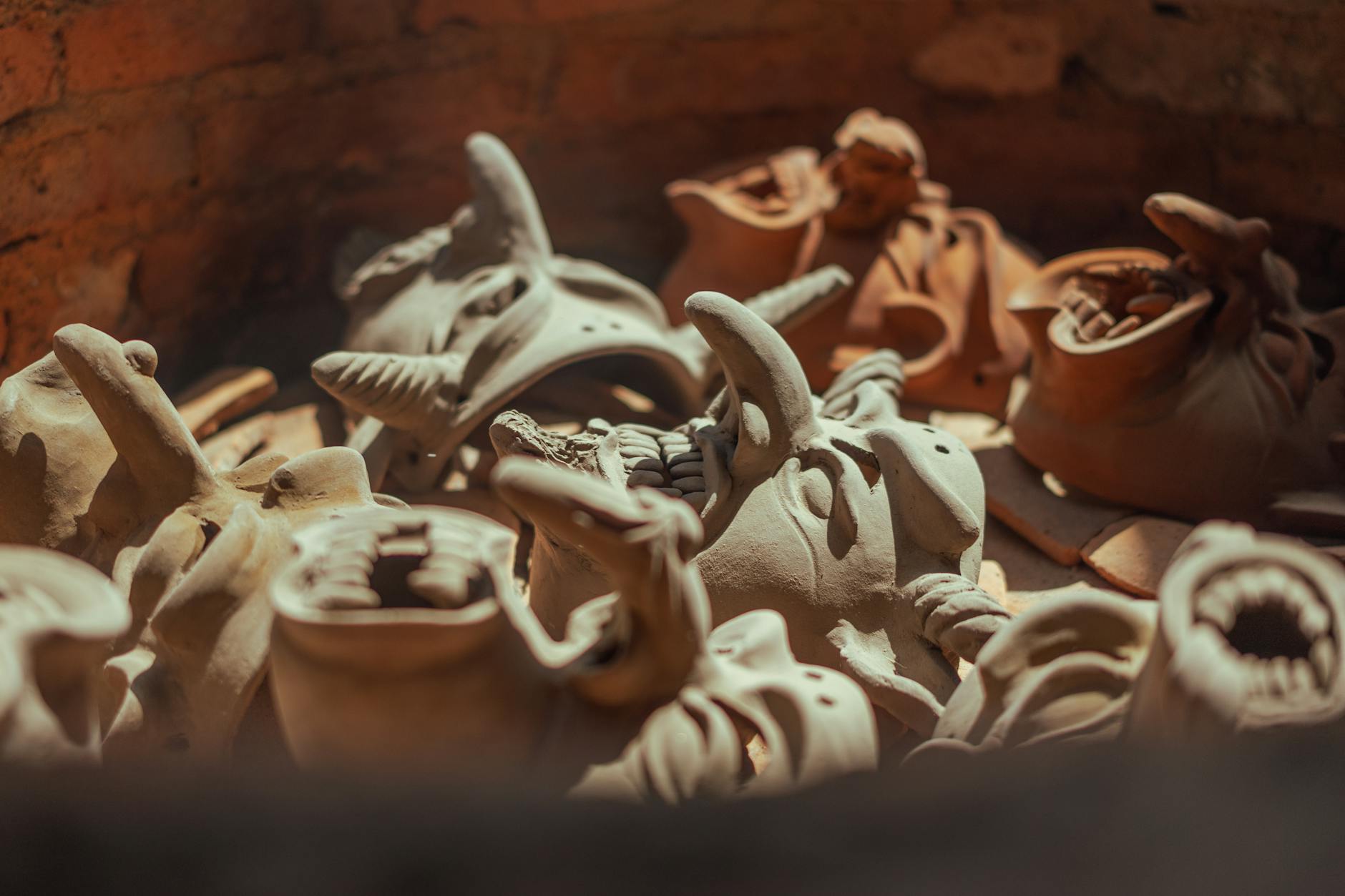
Bisque firing solves this problem. It is a relatively low-temperature first firing that converts your fragile, air-dried greenware into a harder, more stable material called bisqueware (sometimes written as biscuitware, particularly in older British pottery traditions). At this stage the clay is still porous – and that porosity is actually very useful, because it means the bisqueware absorbs glaze readily when you apply it. Once your piece is glazed and thoroughly dried again, a second, higher-temperature firing melts the glaze into a glassy coating and, depending on the clay body and temperature, may also vitrify (densify) the clay itself.
Two firings means more time, more kiln energy, and more patience. But the results are far superior, and the process gives you real control over your work at every stage.
Stage One: The Bisque Firing
What Temperature Is Used?
Bisque firings in the UK typically take place between 900°C and 1000°C, though some potters and studios bisque as low as 850°C or as high as 1060°C depending on their clay body and preferences. Most community studios and college pottery classes in the UK bisque to around 1000°C, which is a solid middle-ground temperature that burns out organic matter and chemically bonded water without over-sintering the clay.
If you are a member of a local pottery studio – whether that is a community space in Manchester, a ceramics cooperative in Bristol, or a college evening class in Edinburgh – the studio manager will almost certainly have a standard bisque temperature they use. Ask them what it is, because knowing this helps you choose compatible glazes later on.
Preparing Your Work for the Bisque
Before anything goes into the kiln, your pieces must be completely bone-dry. This is non-negotiable. Greenware that still contains free moisture can explode in the kiln, and it can damage not just your own work but every other piece in the firing. Always err on the side of caution: a pot that feels dry to the touch may still hold moisture in thicker sections.
Here are the key preparation steps to follow before loading your work into a bisque firing:
- Allow adequate drying time. Thin-walled pieces might be ready within a few days. Thicker work – chunky mugs, sculptural forms, or pieces with varying wall thickness – can take a week or more. In damp British weather, drying takes longer than you might expect. A warm, well-ventilated room speeds things up considerably.
- Check for cracks. Inspect your greenware carefully. Small cracks that are caught before firing can sometimes be repaired with slip (liquid clay), but only while the work is still leather-hard or just turning bone-dry. Once bisqued, repairs become much harder.
- Remove sharp burrs and rough edges. Use a piece of fine sandpaper or a slightly damp sponge to smooth any rough edges on your dried greenware. This is much easier to do before firing than after.
- Check that lids fit. If you are firing a lidded pot, check that the lid still fits reasonably well after drying, as clay shrinks during drying and again during firing. Lids and pots should be fired together to ensure they shrink at the same rate.
- Pack your kiln thoughtfully. Unlike glaze firings, bisqueware pieces can touch each other and can even be stacked inside one another (carefully). This makes bisque firings relatively forgiving in terms of packing efficiency. That said, do not force pieces together – if the kiln is packed too tightly, airflow is restricted and the firing can be uneven.
What Happens Inside the Kiln?
As the kiln heats up, several important chemical and physical changes occur. First, any remaining free water evaporates. Then, as temperatures rise past around 573°C, a phase change called quartz inversion takes place – the silica crystals in the clay shift structure slightly, which is why kilns must rise in temperature slowly during this phase to avoid thermal shock cracking. Around 600-700°C, organic matter in the clay burns away completely. By the time the kiln reaches its target temperature, the clay has undergone a permanent physical and chemical transformation. It can no longer be dissolved back into workable clay by adding water. It is bisqueware.
The kiln then goes through a controlled cool-down. This is equally important – rapid cooling can cause cracking just as surely as rapid heating. Most kilns in studio settings are simply switched off and left to cool with the door shut, which can take many hours. Resist the temptation to open the kiln early. A good rule of thumb is not to open the lid or door until the temperature gauge reads below 100°C – or, if you have no gauge, until the kiln is completely cool to the touch on the outside.
Stage Two: The Glaze Firing
Choosing and Applying Your Glaze
Once your work has come out of the bisque firing, it is time for one of the most creatively satisfying parts of ceramics: glazing. Glaze is, at its most basic, a mixture of minerals that melt together at high temperature to form a glass-like coating. It makes your pottery watertight, food-safe (when properly formulated), and visually stunning.
UK potters are fortunate to have access to a wide range of excellent glaze suppliers. Companies such as Potclays in Stoke-on-Trent, CTM Potters Supplies in Longton, and Scarva Pottery Supplies in Northern Ireland all stock ready-made commercial glazes that are straightforward for beginners to use. Many of these come in clearly labelled buckets or bottles with guidance on firing temperatures. Always read the label and match the glaze to your clay body and firing temperature – a glaze designed for stoneware at 1280°C will not work properly over earthenware bisqueware if you are only firing to 1060°C.
There are several ways to apply glaze to bisqueware:
- Dipping – submerging the piece in a bucket of glaze for a few seconds. This gives an even, consistent coat and is the method most professional potters use. It requires a reasonable quantity of glaze and a bucket large enough to accommodate your work.
- Pouring – pouring glaze over the piece, either inside or outside or both. This is useful for larger pieces that cannot easily be dipped, and can produce beautiful layering effects.
- Brushing – applying glaze with a brush in multiple coats. This is the most accessible method for beginners working at home or in studios with limited glaze stocks. It does require patience and multiple layers (usually three) to achieve an even coat.
- Spraying – using a spray gun and a spray booth. This gives excellent control and very even coverage, but it requires proper ventilation equipment and health and safety considerations, so it is typically only used in well-equipped professional studios.
Whatever method you use, always wax or clean the bottom of your pieces – the foot ring and base – before applying glaze. Any glaze left on the bottom of a pot will melt and stick to the kiln shelf permanently during firing, ruining both the shelf and your work. Wax resist is sold by most pottery suppliers and is applied to the base before glazing; it prevents glaze from adhering to the waxed areas. Alternatively, you can carefully wipe glaze away from the base with a damp sponge after dipping or brushing.
Firing Temperatures and Kiln Atmospheres
Glaze firings happen at higher temperatures than bisque firings, and the exact temperature depends entirely on the clay and glazes you are using. There are broadly three temperature ranges that UK potters work within:
- Earthenware – typically fired between 1060°C and 1150°C. This includes terracotta and many brightly coloured clays. Earthenware remains porous even after the glaze firing, which is why the glaze itself is what provides waterproofing. It is a great starting point for beginners.
- Stoneware – typically fired between 1200°C and 1300°C. At these temperatures, the
clay body vitrifies — meaning the particles fuse together and the pottery becomes dense, non-porous, and significantly stronger. Stoneware is widely used by professional potters across the UK and is well suited to functional pieces such as mugs, bowls, and casseroles that need to withstand daily use. - Porcelain – typically fired between 1260°C and 1300°C, though some porcelain bodies go higher. Porcelain is a refined, white-burning clay that produces work of exceptional translucency and smoothness. It is more demanding to work with than stoneware or earthenware, but the results can be striking. Many UK potters reserve porcelain for decorative or sculptural pieces where its particular qualities are most evident.
It is worth noting that glaze firing temperatures must be matched carefully to the clay body you are using. Firing an earthenware clay to stoneware temperatures, for instance, will cause it to bloat or collapse entirely. Equally, a glaze formulated for stoneware will not melt properly at earthenware temperatures and will appear dry and underfired. Most suppliers in the UK label their clays and glazes clearly with the appropriate temperature range, usually expressed as a cone rating alongside the Celsius figure, so always check before committing to a firing schedule.
Atmosphere inside the kiln is another variable that experienced potters pay close attention to. Electric kilns, which are the most common choice for studio potters in the UK, fire in an oxidising atmosphere — meaning oxygen circulates freely throughout the chamber. Gas kilns can be run in reduction, where oxygen is restricted and carbon affects the clay and glaze surfaces, producing distinctive, often unpredictable results. Reduction firing is particularly associated with certain stoneware and porcelain traditions, and some UK potters invest considerable time in learning to control it.
Conclusion
Bisque firing and glaze firing each serve a distinct purpose, and understanding the relationship between them is fundamental to producing consistent, well-finished work. The bisque stage prepares your pottery to accept glaze reliably, while the glaze firing brings both clay and surface coating to their final, permanent state. Whether you are working with earthenware terracotta in a small studio or throwing porcelain on a production wheel, the two-stage process remains the same in principle. Getting to know your kiln, your clay, and your glazes — and keeping accurate records of every firing — is the most straightforward way to build confidence and improve your results over time.