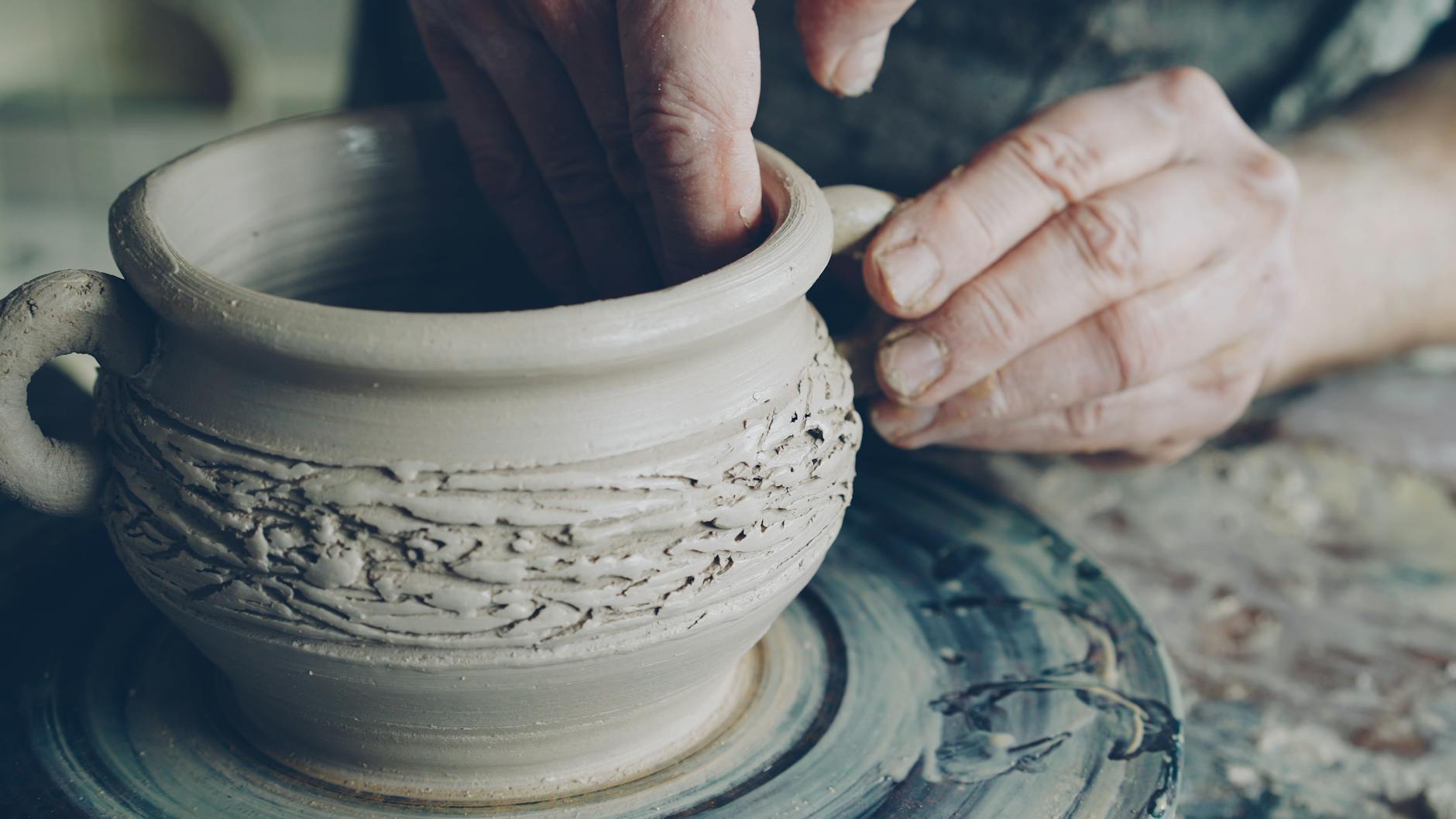
Hand Building vs Wheel Throwing: Which Should You Try First?
So you’ve decided you want to give pottery a go. Perhaps you spotted someone throwing on a wheel in a café window, or you’ve been staring at a beautiful handmade mug on your kitchen shelf wondering how on earth someone made that. Whatever brought you here, welcome — you’re about to discover one of the most absorbing, occasionally maddening, and genuinely rewarding crafts there is.
The first question most beginners face is also one of the most important: should you start with hand building or wheel throwing? It sounds like a small decision, but it shapes your entire early experience of pottery. Get it right and you’ll fall in love with the craft. Get it wrong — or rather, choose without thinking it through — and you might struggle unnecessarily and wonder why everyone else seems to be having such a good time.
This guide will walk you through both techniques honestly, without sugarcoating the tricky bits, so you can make a proper informed choice before you book that first class or buy your first bag of clay.
What Is Hand Building?
Hand building is exactly what it sounds like: constructing pottery using your hands, without a wheel. It’s the oldest form of ceramics in human history, and it’s still very much alive and well today — not as a consolation prize for people who can’t throw, but as a legitimate and highly skilled discipline in its own right.
There are three main hand building techniques you’ll encounter:
- Pinch pot: You start with a ball of clay and pinch it outward from the centre using your thumb and fingers. Simple in concept, endlessly nuanced in practice. It’s usually the very first thing beginners are taught.
- Coil building: You roll long sausages of clay and stack them on top of each other to build up the walls of a piece, smoothing and blending as you go. This technique allows for taller, more complex forms.
- Slab building: You roll out flat sheets of clay — much like rolling pastry — and cut them into shapes that you join together. Slab work is brilliant for angular, architectural forms: boxes, tiles, vases with flat sides, and so on.
Most hand building classes will introduce you to all three over the course of a term. You can mix techniques too — there are no rules saying you can’t pinch a base and then coil the walls upward.
What Is Wheel Throwing?
Wheel throwing involves placing a lump of clay on a spinning wheel and using your hands to centre it, open it up, and pull the walls upward into a symmetrical form. The wheel does not do the work for you — that’s a common misconception. The wheel provides rotation; your hands, pressure, and patience do everything else.
It’s the technique most people picture when they think of pottery, largely thanks to films and television. What those depictions rarely show you is the first three months of frustrating wobbly cylinders, collapsing bowls, and clay-covered everything. That’s not said to put you off — it’s said because knowing what to expect means you won’t give up when it happens to you.
Wheel throwing is genuinely exhilarating once things start clicking into place. There’s a particular satisfaction in pulling up a tall, even cylinder that simply doesn’t exist in any other craft. But it demands consistent practice, and consistency takes time.
The Honest Differences Between the Two
Before you choose, it helps to understand where the two techniques genuinely differ — not just in method, but in feel, pace, and the kind of mindset they suit.
Learning curve: Hand building has a gentler initial learning curve. Within your first session, you can produce something that looks intentional and is structurally sound. On the wheel, your first session is almost entirely spent learning to centre the clay — a deceptively difficult skill that can take weeks to master properly. That’s not failure; that’s just how it works. But it does mean hand building delivers earlier wins, which matters for motivation.
Physical demand: Wheel throwing requires more upper body strength and grip than most people expect. Centring in particular involves pressing down and inward on a spinning mass of clay with considerable force. If you have wrist, hand, or shoulder issues, it’s worth mentioning this to your tutor before you start. Hand building is generally less physically demanding, though rolling coils and slabs for extended periods can still tire your hands.
Precision vs. expression: The wheel tends to produce rotationally symmetrical, round forms. That’s its nature. Hand building gives you far more freedom in shape — you’re not constrained by the physics of rotation. If you’re drawn to organic, irregular, sculptural work, hand building will serve you better from the start.
Equipment at home: If you eventually want to practise at home, a potter’s wheel is a significant investment — decent electric wheels from suppliers like Potterycrafts or Axner start from around £500 to £800 new, and you’ll need space for it too. Hand building requires far less: a canvas board or piece of hessian, a rolling pin, some basic tools, and clay. It’s a much lower barrier to entry for home practice.
The meditative quality: Both techniques are often described as meditative, but in different ways. Wheel throwing requires intense focus — your mind really cannot wander, because the moment it does, your pot collapses. Hand building, particularly coiling, can be slower and more contemplative, more akin to knitting in its rhythm. Neither is better; it depends entirely on what you’re looking for.
Who Tends to Suit Hand Building?
Hand building might be the better starting point if any of the following sound like you:
- You’re drawn to sculptural, non-symmetrical, or textured work rather than classic round pots and bowls.
- You want to see results relatively quickly to keep your motivation going.
- You’re interested in eventually working from home without a large equipment investment.
- You have physical limitations that might make the sustained pressure of centring difficult.
- You prefer working at your own pace without the time pressure that a spinning wheel creates.
- You’re already interested in sculpture, textiles, or other tactile crafts where form and texture are central.
Many excellent potters — including some selling through UK craft fairs and on platforms like Folksy — work exclusively in hand building and never touch a wheel. It’s a complete discipline, not a stepping stone.
Who Tends to Suit Wheel Throwing?
The wheel might be the right starting point if:
- You’re drawn specifically to functional ware — mugs, bowls, plates, jugs — with that classic thrown look.
- You thrive on technical challenges and find the process of mastering a difficult skill motivating rather than discouraging.
- You have regular, consistent access to a wheel, ideally through a local class or studio.
- You’re patient. Genuinely patient. The wheel rewards persistence like almost nothing else in craft.
- You enjoy the physical, full-body engagement of the process.
It’s also worth saying: plenty of people try the wheel, struggle with it initially, and wish they’d started with hand building first to develop their feel for clay before adding the complexity of a spinning wheel. There’s real wisdom in that approach, and many pottery tutors in the UK now recommend it explicitly.
Finding a Class in the UK
Whatever you decide, a proper class with a good tutor is far more valuable than trying to teach yourself from YouTube alone — at least in the beginning. Clay has a way of developing bad habits that are very difficult to unlearn, and a tutor catches them early.
Here are some practical steps for finding a class near you:
- Search the Craft Potters Association (CPA) directory. The CPA is the UK’s leading professional body for studio potters and maintains a list of member potters, many of whom teach. Their website at craftpotters.co.uk is a good starting point.
- Check your local adult education college. Many further education colleges across England, Scotland, Wales, and Northern Ireland offer pottery courses through their continuing education programmes. These tend to be excellent value — often substantially subsidised — and are well-structured for beginners.
- Look for independent studios. Cities like London, Bristol, Edinburgh, Manchester, Leeds, and Brighton all have thriving communities of independent pottery studios offering classes. Search for “[your town or city] pottery class” and look for studios with clear beginner programmes and visible student work on their social media.
- Ask about trial sessions. Many studios offer one-off taster sessions before you commit to a full term. This is a brilliant way to try both hand building and wheel throwing before deciding which to pursue, if a studio offers both.
- Check community centres and arts centres. Places like Cockpit Arts in London or The Biscuit Factory in Newcastle often host or can point you toward ceramics classes. Smaller community studios sometimes offer the most welcoming environments for absolute beginners.
- Look into evening and weekend courses. Most pottery classes run on evenings or weekends to accommodate working adults. A typical beginner’s term is six to ten weeks, usually two hours per session.
When you contact a studio or tutor, don’t be shy about asking which technique they recommend for beginners, and why. Their answer will tell you a lot about their teaching philosophy and whether it aligns with what you’re looking for.
What to Expect from Your First Session
Whichever path you choose, your first session will involve getting acquainted with clay itself — and that takes a little time. Clay straight from the bag needs to be wedged (kneaded) before use to remove air bubbles and make it consistent in texture. Your tutor will show you how. It’s harder than it looks and easier than it seems after a bit of practice, which is a reasonable summary of pottery in general.
Wear clothes you don’t mind ruining. Clay gets everywhere — on your forearms, your jeans, sometimes your face. Most studios provide aprons, but your hands and wrists will be thoroughly clay-covered by the end. This is part of the experience, not a problem to be solved.
Bring a willingness to make ugly things. Your first pinch pot will probably be uneven. Your first cylinder on the wheel will
probably collapse, or wobble off-centre, or simply refuse to rise in the way you imagined it would. None of this means you have no talent. It means you are learning a physical skill, and physical skills take repetition. Professional potters have collapsed thousands of cylinders. The difference between a beginner and an experienced potter is largely just accumulated failure, which is a more encouraging thought than it first appears.
What you will almost certainly find, regardless of which method you choose, is that an hour at the wheel or the worktable passes very quickly. Pottery demands a particular kind of attention — your hands are occupied, the problem in front of you is immediate and tactile, and there is no sensible way to check your phone while covered in slip. Many people describe their first session as unexpectedly absorbing. Some book a second session before they have even washed their hands. This is normal, and the studios are used to it.
If you genuinely cannot decide between hand building and wheel throwing, the straightforward answer is to try both before committing to either. Many UK studios offer taster sessions for precisely this reason, and a single afternoon on the wheel followed by a hand building morning will tell you more about your own preferences than any amount of reading. Some people find they love both and rotate between them depending on what they want to make. Others discover a firm allegiance within the first session. Either outcome is fine.
There is no correct starting point in pottery, only the one you actually take. Hand building is more forgiving of interrupted concentration and works well if you enjoy making things at your own pace without relying on mechanical rhythm. Wheel throwing offers a different satisfaction — the discipline of centring, the slight drama of a form rising under your hands — and tends to produce a particular kind of obsessive enthusiasm in those it suits. Both paths lead to the same place: a growing understanding of clay, a collection of slightly lopsided objects you will feel unreasonable affection for, and the likelihood that you will want to keep going.